
UnityReach Global · Project
UnityReach Global Community, Mission & Family Development Campus
Cap-Haïtien, Haiti · Concept planning, professional feasibility review, and fundraising
A proposed permanent operational center that houses mission teams and keeps serving the community year-round with healthcare, food access, recreation, employment and family activities.
Official GoFundMe campaign
Help Us Begin the First Phase
GoFundMe campaign total
Raised on GoFundMe
$0
First-phase goal
$2,000,000
Still needed
$2,000,000
0% of the first-phase goal. This figure refreshes automatically as the campaign total is confirmed.
Help Us Begin the First Phase
SapiBon Foundation has launched an official GoFundMe campaign to support the first phase of the proposed UnityReach Global Campus in Cap-Haïtien, Haiti. Our $2 million first-phase goal will help support site evaluation, potential land acquisition, title review, surveys, environmental and geotechnical studies, architectural services, engineering, approvals and project planning.
The complete campus currently has a preliminary planning estimate of approximately $30 million. The $2 million GoFundMe campaign represents the first development phase and is not the complete project budget. All costs, facilities and timelines remain subject to professional, regulatory, financial and community review.
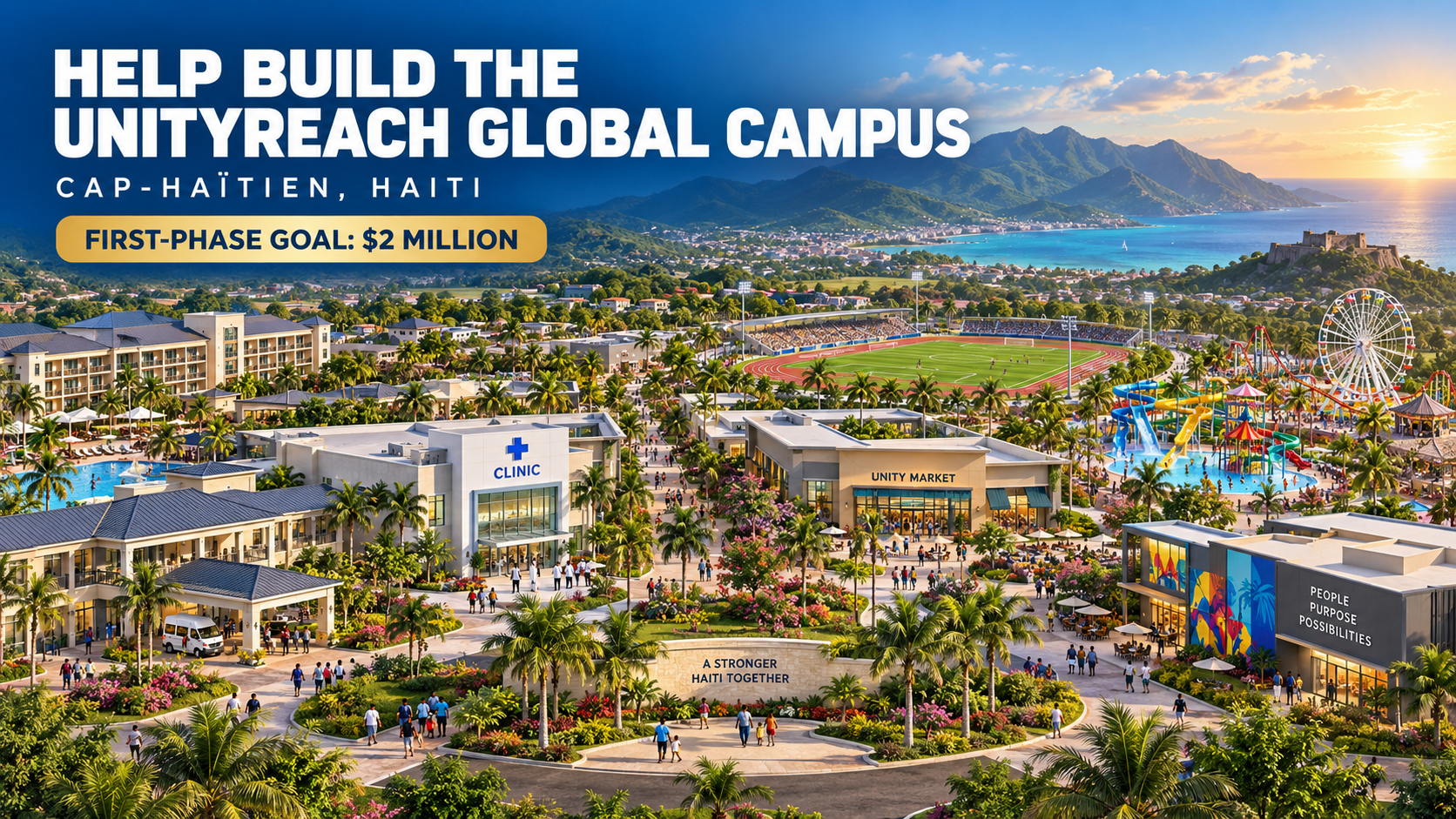
Official GoFundMe campaign · Concept Planning and Fundraising
Help Build the UnityReach Global Campus in Haiti
Help SapiBon Foundation begin developing a permanent mission and community campus in Cap-Haïtien, Haiti, with volunteer accommodations, healthcare, food access, recreation, employment opportunities and year-round community services.
- First-phase goal
- $2,000,000
- Verified amount raised
- Not yet verified
- Remaining to goal
- $2,000,000
Campaign totals are published here once an administrator verifies them. Pledges and in-kind gifts are reported separately and are never counted as money received.
The UnityReach Global Campus is currently in concept planning and fundraising. The master-plan image is conceptual. Final land acquisition, site boundaries, building locations, facilities, costs, approvals and construction schedules remain subject to professional and regulatory review.
Project overview
Why a permanent campus
Instead of repeatedly paying for temporary lodging, event venues, clinics, storage, transportation support and activity spaces for every mission, this project would establish a permanent operational center in Cap-Haïtien.
The proposed campus provides accommodations for mission volunteers while offering healthcare, food access, recreation, employment, entertainment and community services throughout the year.
After mission teams return home, the clinic, grocery store, hospitality facilities, sports areas, entertainment attractions and family fair can continue serving the community and generating revenue that supports operations, maintenance, employment and future humanitarian programs.
- Guest rooms
- 200
- Guests per room
- Up to 6
- Planned lodging capacity
- 1,200 guests
- Enclosed facilities
- ≈ 175,000 sq ft
- Base construction target
- $60 per sq ft
- Base enclosed allowance
- $10,500,000
- Preliminary project budget
- $30,000,000
- Location
- Cap-Haïtien, Haiti
Fundraising progress
Where the campaign stands
Verified pledges are reported separately and are never added to money actually received.
Campaign goal
$30,000,000
Received to date
$0
Verified pledges (not yet received)
$0
Remaining to goal
$30,000,000
0% of the goal received.
Campus master plan
How the campus is organised
The plan separates public services, ticketed entertainment, fair activities, private guest lodging and staff operations.
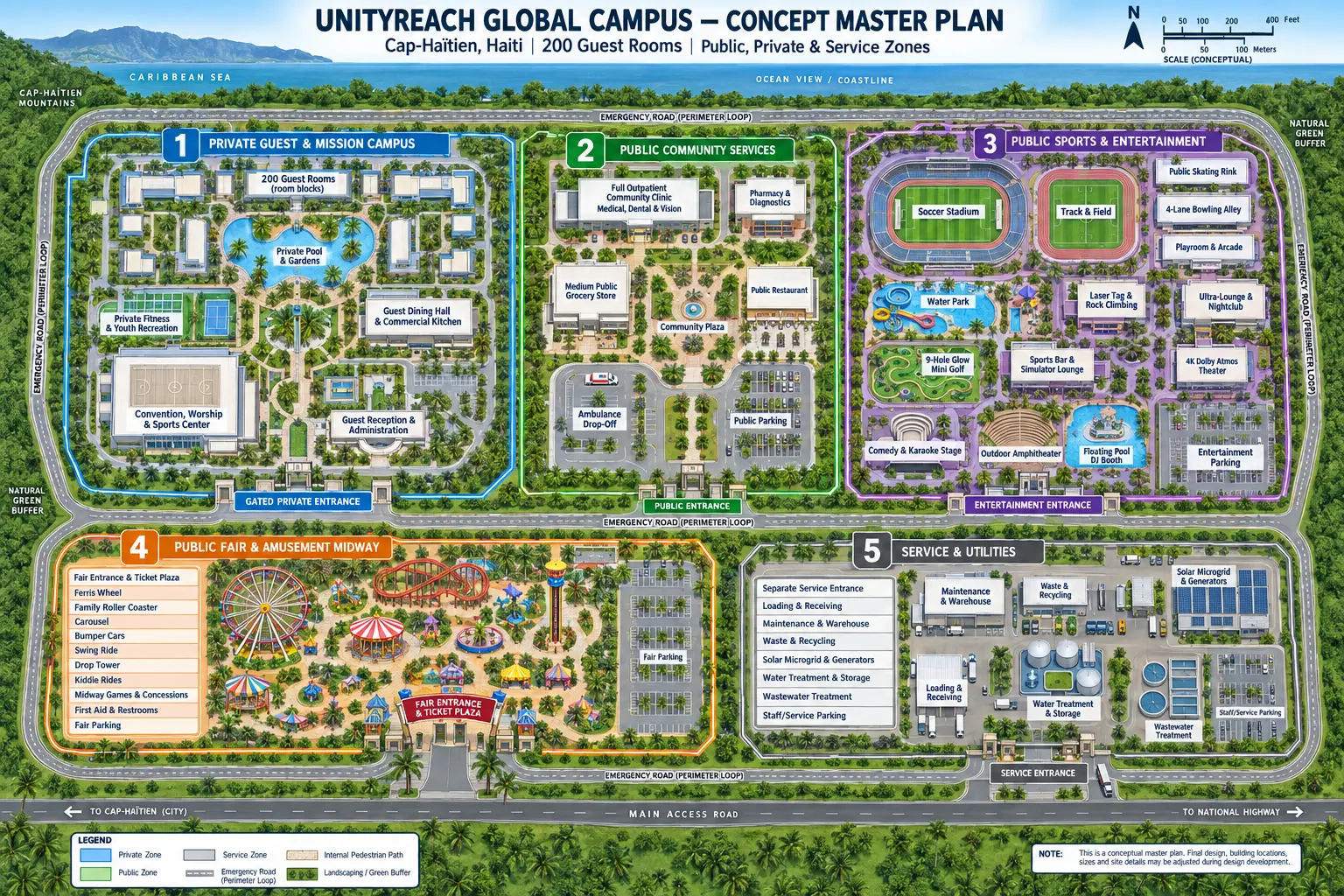
- Public community services
- Ticketed public entertainment
- Public fair activities
- Private guest accommodations
- Staff and service operations
Public visitors would not enter the private lodging campus without authorization. Service vehicles, deliveries, waste collection, ambulances and emergency vehicles would use designated routes.
Private guest and mission campus
A secure, gated area reserved for mission volunteers, separated from all public facilities.
- 200 flexible guest rooms
- Capacity for up to six people per room during group missions
- Gated private entrance
- Guest reception and administration
- Dining hall
- Commercial kitchen
- Convention, worship and sports center
- Private swimming pool
- Gardens and walking areas
- Fitness and youth-recreation facilities
- Laundry and housekeeping support
- Volunteer meeting and training rooms
- Secure separation from public facilities
Public community services
Year-round services for Cap-Haïtien families, open long after mission teams return home.
- Full outpatient community clinic
- Medical services
- Dental services
- Vision services
- Pharmacy support
- Diagnostic services
- Patient registration and waiting areas
- Ambulance drop-off
- Medium public grocery store
- Fresh, frozen, refrigerated, household and essential goods
- Public restaurant
- Community plaza
- Public parking
Clinical services will only operate under properly qualified professionals and required Haitian authorization.
Public sports and entertainment
Recreation and cultural venues that serve families and generate revenue to sustain campus operations.
- Soccer stadium
- Track-and-field facilities
- Public skating rink
- Public four-lane bowling alley
- Public playroom and arcade
- Public water park
- Public laser-tag and rock-climbing arena
- Private ultra-lounge and nightclub for eligible adult patrons
- 4K luxury Dolby Atmos theater
- High-tech sports bar and simulator lounge
- Nine-hole glow-in-the-dark miniature-golf course
- Acoustic comedy and karaoke stage
- Outdoor amphitheater
- Leisure pool with floating DJ booth
- Entertainment entrance, ticketing, security and parking
Public fair and amusement midway
A family fairground with its own entrance, circulation and safety provisions.
- Separate fair entrance
- Ticket plaza
- Ferris wheel
- Family roller coaster
- Carousel
- Bumper cars
- Swing ride
- Drop tower
- Kiddie rides
- Midway games
- Food concessions
- Fair parking
- Restrooms
- First-aid station
- Service and loading access
- Emergency circulation route
Every ride will require professional design coordination, manufacturer certification, installation review, inspections, trained operators, maintenance procedures, emergency plans, and applicable government approval before opening.
Service and utility infrastructure
Resilient systems so the campus can operate independently and safely.
- Separate service entrance
- Loading and receiving area
- Warehouse and maintenance facilities
- Waste and recycling area
- Solar microgrid
- Battery storage
- Backup generators
- Water treatment and storage
- Wastewater treatment
- Fire-water reserve
- Staff and service parking
- Campus-wide communications and security
- Emergency perimeter road
One campus, five connected zones
Every zone is planned to work together: the private mission campus stays secure, public services run year-round, recreation and fair venues help sustain operations, and shared utilities keep the whole site independent and safe.
All facilities remain conceptual and subject to professional, regulatory and financial validation.
Preliminary budget
Planning allowances by category
The $30 million figure is a preliminary planning estimate, not a contractor quotation or a guaranteed construction price. Final cost, acreage, building sizes, schedule, and construction phases must be established by qualified architects, engineers, Haitian authorities, contractors, quantity surveyors, and equipment vendors.
| Category | Preliminary allowance |
|---|---|
| Total preliminary project budget | $30,000,000 |
Help Us Begin the First Phase
SapiBon Foundation has launched an official GoFundMe campaign to support the first phase of the proposed UnityReach Global Campus in Cap-Haïtien, Haiti. Our $2 million first-phase goal will help support site evaluation, potential land acquisition, title review, surveys, environmental and geotechnical studies, architectural services, engineering, approvals and project planning.
The complete campus currently has a preliminary planning estimate of approximately $30 million. The $2 million GoFundMe campaign represents the first development phase and is not the complete project budget. All costs, facilities and timelines remain subject to professional, regulatory, financial and community review.
Development phases
A staged, fundable sequence
Each phase begins only when funding and required approvals are in place.
Economic and community impact
What the campus could mean for Cap-Haïtien
Anticipated outcomes described as goals of the project, not as guaranteed results.
- Expanded access to medical, dental and vision services
- Affordable access to food and household essentials
- Employment and professional-training opportunities
- Year-round economic activity
- Support for future mission teams
- Youth recreation and family activities
- Sports and cultural programming
- Local purchasing and vendor opportunities
- Revenue to help sustain charitable programs
- Long-term community partnerships
Ways to support the project
Give, sponsor, partner or contribute expertise
Donation designations are recorded as donor preferences unless SapiBon Foundation has formally established legally restricted project funds.
Gift designations available
- General Campus Fund
- Land Acquisition
- Guest Accommodations
- Community Clinic
- Grocery Store
- Water and Power Infrastructure
- Sports and Youth Facilities
- Entertainment District
- Public Fair and Rides
- Furniture and Equipment
- Professional Design and Engineering
Project documents
Documents and downloads
Documents are published here as they are completed and approved.
- No project documents have been published yet.
Updates and progress
Project updates
Progress reporting is published as planning milestones are reached.
No updates have been published yet. Check back as planning progresses.
Questions
Frequently asked questions
- Has land been purchased for the campus?
- No. Land acquisition is part of Phase 0 and is subject to title verification, survey and legal review under Haitian law. No purchase, ownership or contractor commitment is being announced.
- Is the $30 million figure a construction quote?
- No. It is a preliminary planning allowance used for fundraising discussion. Qualified architects, engineers, contractors and quantity surveyors must establish real costs.
- When will the campus open?
- No opening date has been set. The project is in concept planning and professional feasibility review, and each phase depends on funding and required approvals.
- Why build a permanent campus instead of renting for each mission?
- Recurring lodging, venue, clinic, storage and transportation costs are paid again for every mission. A permanent center keeps serving the community year-round and can generate revenue that supports operations, maintenance, employment and future programs.
- Will public visitors have access to volunteer lodging?
- No. The master plan keeps private guest accommodations separated from public services, ticketed entertainment and the fair, with authorized access only.
- Can I direct my gift to a specific part of the campus?
- You can express a preference. Unless SapiBon Foundation has formally established legally restricted project funds, designations are treated as donor preferences and gifts support the campus project overall.
Compliance and safety
Requirements before anything is built or opened
No construction approval, land ownership, contractor commitment, partnership or opening date is being claimed.
- Haitian permits and professional approvals
- Land-title verification
- Environmental and drainage studies
- Structural, seismic, wind and flood resilience
- Clinical authorization
- Food-safety requirements
- Ride inspections and certification
- Fire and life safety
- Accessibility
- Safeguarding
- Insurance
- Financial controls
- Construction procurement
- Community consultation
The $30 million figure is a preliminary planning estimate, not a contractor quotation or a guaranteed construction price. Final cost, acreage, building sizes, schedule, and construction phases must be established by qualified architects, engineers, Haitian authorities, contractors, quantity surveyors, and equipment vendors.